

Millions of people around the world do not have reliable access to enough food. Others have full fridges but do not get the nutrients they need. And in hospitals, malnutrition often goes unrecognised until it begins to affect a patient’s recovery.
We live in an age of exceptional access to food, a wide variety of products and an ever-increasing amount of information about nutrition. And yet the world continues to face two seemingly contradictory problems – hunger and malnutrition on the one hand, and excessive consumption, obesity and dietary imbalances on the other.
According to the report The State of Food Security and Nutrition in the World 2026 According to the Food and Agriculture Organisation of the United Nations (FAO), approximately 645 million people were hungry in 2025. This represents 7.8 per cent of the world’s population.
At the same time, the report Food Waste Index Report 2024 A report by the United Nations Environment Programme (UNEP) finds that approximately 1.05 billion tonnes of food were wasted worldwide in 2022. Households are responsible for 60 per cent of this amount – the equivalent of over one billion meals a day.
These figures reveal much more than just the uneven distribution of food resources. They raise the question of how we understand access to food and what a balanced diet actually means.
This is because having enough calories does not necessarily mean that the body is getting the protein, vitamins, minerals and other nutrients it needs.
When we talk about malnutrition, we often picture people who are severely underweight, suffering from severe malnutrition or living in extreme poverty. The reality is considerably more complex.
In Bulgaria, the affordability of high-quality food remains a major challenge.
According to figures from the National Statistical Institute for 2025, around 15.9 per cent of the population cannot afford to eat meat, fish or a suitable plant-based alternative at least once every two days.
By comparison, in 2024 this proportion stood at 18.7 per cent. Although there has been some improvement, Bulgaria remains among the EU countries facing significant difficulties in terms of access to adequate nutrition.
This is not just a statistic on income. Behind it lie real people, families, elderly patients and children, for whom food choices are often determined not by dietary recommendations, but by financial circumstances.
In the UK, the picture looks different, but it is far from ideal.
According to the British organisation BAPEN (British Association for Parenteral and Enteral Nutrition), over 3 million people in the UK are malnourished or at risk of becoming so. Most of them live in the community, and over 1 million are aged 65 or over.
Even more telling are the results of the 2023 BAPEN national survey, published on 5 November 2024. The survey included 2,250 adults from the United Kingdom and the Republic of Ireland.
The results show that 48 per cent of the participants were at risk of malnutrition according to the MUST (Malnutrition Universal Screening Tool).
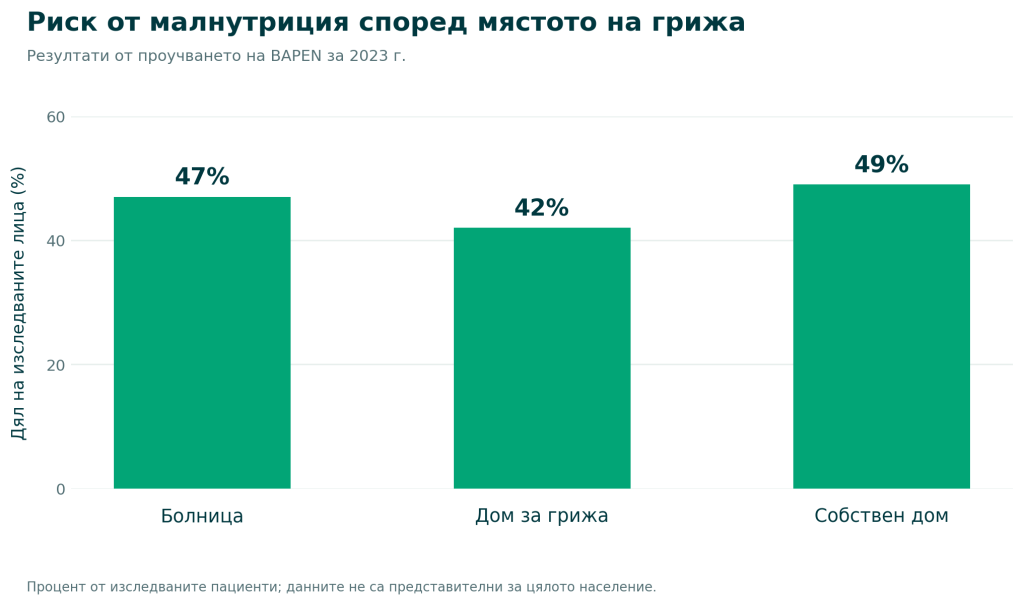
The breakdown by care setting is particularly interesting:
It is important to note that this is a study of screened patients and does not constitute a nationally representative survey of the entire population. Nevertheless, the results highlight the scale of the problem across different health and social settings.
One of the key differences between Bulgaria and the UK is the way in which food risk identification and management are organised.
In the UK, there are established tools and clinical practices for screening for and assessing malnutrition. MUST is widely used across various health and social care settings, whilst NICE and BAPEN provide guidance on identifying and managing nutritional risk.
However, this does not mean that every patient receives timely and appropriate nutritional care.
In the 2023 BAPEN study, a dietary plan was available for only 56 per cent of all patients surveyed. Even amongst those at high nutritional risk, not all had a documented dietary intervention plan.
This raises an important question: is it enough simply to recognise the problem if we do not then take action?
In Bulgaria, too, there are specialists, clinical dietitians and medical teams who are actively working to improve nutritional care. The challenge also lies in the need for a more systematic approach to screening, standardised assessment, multidisciplinary work and follow-up.
At present, there is a lack of sufficient comparable national data to allow for a reliable comparison of the prevalence of clinical malnutrition amongst adult hospitalised patients in the two countries.
This in itself is an important reason to invest in more research and the systematic collection of data.
One of the most common myths is that malnutrition is always associated with low body weight.
In fact, a person can be overweight or obese and, at the same time, be malnourished.
This is particularly important for patients with chronic conditions, cancer, inflammatory conditions and those who have undergone surgery.
Loss of muscle mass, insufficient protein intake, unintentional weight loss and increased nutritional requirements may go unnoticed when attention is focused solely on body weight or BMI.
That is why modern clinical practice requires much more than simply weighing patients in kilograms.
An assessment of dietary intake, changes in body weight, muscle mass, functional status, the presence of inflammation and the underlying condition is required.
This is precisely where modern diagnostic approaches, including the GLIM criteria, come into play, as they enable a more structured diagnosis of malnutrition.
It is particularly worrying that malnutrition can actually worsen during a hospital stay.
A patient may be admitted to hospital in a good nutritional state, but may develop a significant nutritional deficit as a result of surgery, infection, inflammation, pain, nausea, loss of appetite or prolonged restriction of food intake.
Here, nutrition should not be regarded as a supplement to treatment, but as an integral part of it.
Let’s consider a question that seems straightforward at first glance: is it appropriate for a patient who has undergone abdominal surgery to eat cabbage?
There is no one-size-fits-all answer. It depends on the type of operation, the condition of the gastrointestinal tract, the prescribed diet and individual tolerance.
The same applies to the choice of diet.
The decision regarding nutritional intervention must be tailored to the individual and take into account the patient’s clinical condition.
This requires collaboration between doctors, clinical dietitians, nurses, pharmacists and other members of the multidisciplinary team.
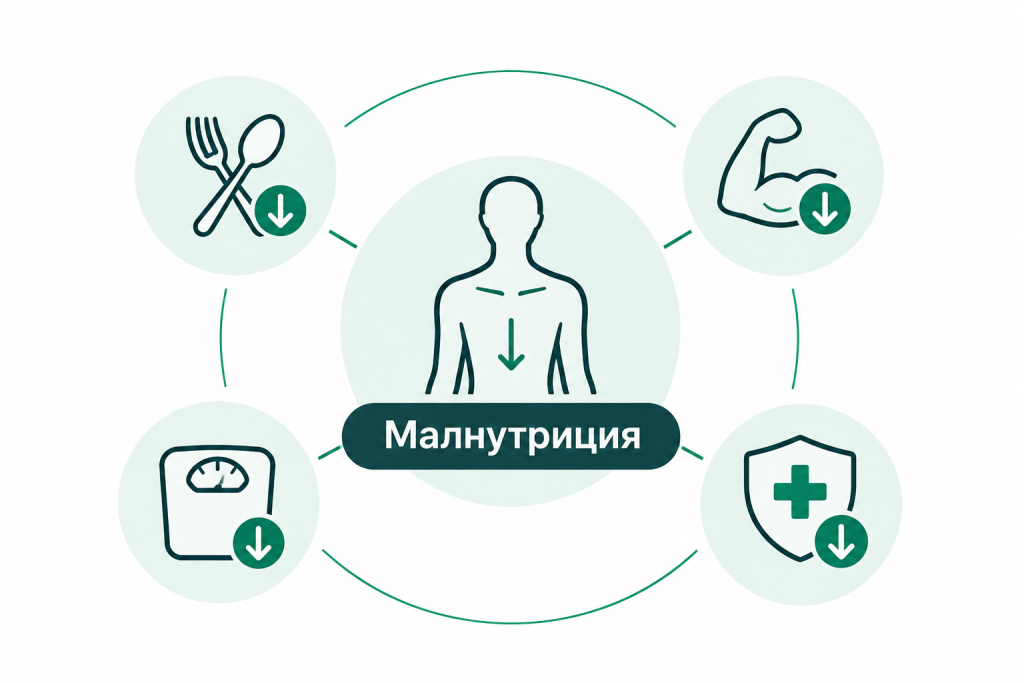
The consequences of malnutrition go far beyond weight loss. Inadequate intake of energy, protein and essential nutrients can lead to a loss of muscle mass and strength, impaired physical function, a weakened immune system and impaired wound healing. For hospitalised patients, this can mean a higher risk of infections and other complications, a longer hospital stay, delayed recovery and a greater need for subsequent medical and social care. In older people, the consequences can be particularly serious – an increased risk of falls, functional dependence, loss of independence and a reduced quality of life. Prolonged malnutrition can also affect cognitive function, mood and the body’s ability to cope with the underlying illness. Consequently, malnutrition is not merely a consequence of the illness – it can further complicate its course and recovery.
There is another aspect of malnutrition that we need to discuss more often – the medical-legal aspect.
When a patient is at high nutritional risk, who is responsible for identifying this? Who should assess their nutritional needs? Who actually monitors their food intake? And what happens when a nutritional risk has been identified but no adequate action has been taken?
Nutritional care is an integral part of the quality and safety of healthcare.
Screening is only the first step. This is followed by assessment, an individual plan, intervention, monitoring and the documentation of results.
This is precisely why malnutrition must be viewed not only as a nutritional or medical problem, but also as a matter of patients’ rights and professional responsibility.
In this process, the role of the clinical dietitian is essential. They do not simply draw up a dietary plan, but play an active part in the clinical assessment and management of nutritional risk. This includes interpreting screening results, conducting a detailed assessment of nutritional status, analysing dietary intake and requirements, identifying barriers to nutrition, and developing a personalised intervention plan. Depending on the patient’s condition, the dietitian may recommend dietary fortification, oral nutritional supplements, or enteral or parenteral nutrition in collaboration with the rest of the medical team. Equally important are monitoring the effectiveness of the intervention, assessing changes in body composition and functional status, and adapting the dietary plan in a timely manner. The clinical dietitian links scientific evidence to the patient’s individual needs and makes nutritional therapy a measurable part of the treatment process. Therefore, their presence in the multidisciplinary team should not be viewed as an additional service, but as an important component of high-quality and safe medical care.
Experience from the UK shows that the availability of tools, clinical guidelines and professional organisations is important, but is not sufficient in itself.
A consistent system is needed to ensure that food safety risks are identified and addressed in a timely manner.
For Bulgaria, this means several important steps:
From hunger to nutritional deficiencies, from obesity to hospital malnutrition – all these conditions form part of a wider issue: the right to access adequate, safe and nutritious food.
As clinical dietitians, we must not limit ourselves to simply giving advice on what people should eat. It is our responsibility to help identify nutritional risks, to champion the need for adequate nutritional care, and to work towards changing practices.
Because sometimes the problem isn’t that the patient doesn’t have any food in front of them. The problem is that nobody has checked whether they are able to eat it, whether it meets their needs, and what happens when they are unable to eat enough.
Malnutrition is a preventable and treatable problem in many cases. But in order to treat it, we must first recognise it.