

Cow's milk allergy (CMA) is an immune response to the proteins in milk (casein and whey). It differs substantially from lactose intolerance, which is a problem with the digestion of milk sugar (lactose) rather than an immune reaction. ABCD affects about 7% from infants under one year of age, making it one of the most common food allergies in infancy.
Depending on the response of the immune system, there are two main types:
Signs usually appear in the first weeks or months of life. Allergic symptoms can affect different body systems:
Care must be taken in making a diagnosis, as the manifestations of delayed allergic reaction often coincide with common baby problems. Conditions such as diarrhoea, severe colic, reflux or skin irritations (eczema) occur in many babies and are not always a sign of a milk allergy. Allergy is only one of the possible factors to be considered.
If you suspect a cow's milk protein allergy, consult your GP or paediatrician.
Your dietitian will be able to help you in choosing which foods should be excluded from your child's diet, or from yours if you are still breastfeeding.
It is important to know that milk from goats and sheep not a suitable alternative as their proteins are very similar to those of cow's milk.
Your GP is responsible for the diagnosis and long-term follow-up of your child. If confirmed mild to moderate form of delayed allergy, it is advisable to work together with your clinical nutritionist.
However, if there is any doubt about severe form or for immediate reaction (IgE-mediated), the doctor will need to refer you to a specialized pediatric allergy clinic. The GP/paediatrician should immediately prescribe an appropriate hypoallergenic milk and give you instructions on how to avoid cow's milk (including in weaning/feeding formula).
When the time is right, the doctor will discuss with you the careful reintroduction of milk proteins into the diet. This process often follows the so-called. „Milk ladder“ - phased method of feeding:
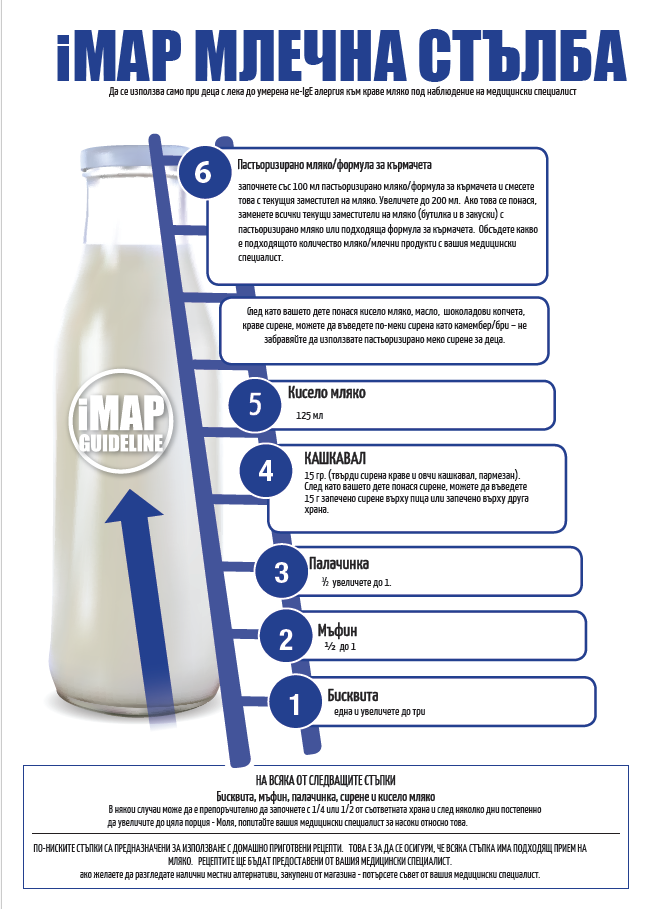
Never start the „Dairy Ladder“ on your own at home without the explicit approval and plan from your doctor or nutritionist.
Allergy UK. Cow's Milk Allergy. Available from: https://www.allergyuk.org/information-and-advice/conditions-and-symptoms/469-cows-milk-allergy [Accessed 03 January 2026].
DU TOIT, G. et al., 2010. Identifying and managing cow's milk protein allergy, 95(5), pp. 134-144. Available from: http://ep.bmj.com/content/95/5/134.full.
FOX, A. et al., 2019. An update to the Milk Allergy in Primary Care guideline, 9(1), pp. 40-n/a. Available from: https://link.springer.com/article/10.1186/s13601-019-0281-8.
GPIFN, 2016. The iMap milk ladder
LIFSCHITZ, C. and SZAJEWSKA, H., 2015. Cow's milk allergy: evidence-based diagnosis and management for the practitioner, 174(2), pp. 141-150. Available from: https://link.springer.com/article/10.1007/s00431-014-2422-3.
LUYT, D. et al., 2014. BSACI guideline for the diagnosis and management of cow's milk allergy, 44(5), pp. 642-672. Available from: https://api.istex.fr/ark:/67375/WNG-H2CLFWX2-7/fulltext.pdf.
NICE, 2025. Cow's milk allergy in children [online]. Available from: https://cks.nice.org.uk/topics/cows-milk-allergy-in-children/#!scenario.
RICHARDS, S., 2007. Food Allergies-Enjoying Life With a Severe Food Allergy, 34(10), p. 20. Available from: https://www.proquest.com/docview/230452514.
STRÓŻYK, A. et al., 2022. World Allergy Organization (WAO) Diagnosis and Rationale for Action against Cow's Milk Allergy (DRACMA) Guidelines update - IV - A quality appraisal with the AGREE II instrument, 15(2), p. 100613. Available from: https://www.proquest.com/docview/2713309885.
VENTER, C. et al., 2017. Better recognition, diagnosis and management of non-IgE-mediated cow's milk allergy in infancy: iMAP-an international interpretation of the MAP (Milk Allergy in Primary Care) guideline, 7(1), pp. 26-n/a. Available from: https://link.springer.com/article/10.1186/s13601-017-0162-y.